I think Washington is closer to having a Big Ten-caliber defense than a Big Ten-caliber offense.
I don't think this is a particularly controversial opinion given this season's results. However, Washington’s coach does not seem to agree.
Here is what Jedd Fisch said during his press conference on Monday:
“Offensively, if you score over 24 points in the Big Ten, teams are 38-9 … we are 1-3 when we’ve scored over 24 points. So we’ve got to find a way to be able to prevent a couple of scores.”
Now, at the risk of being a pedantic twit, I’m going to correct the phrasing: In Big Ten conference games this season, Washington is 1-3 when it scores 24 or more points. The rest of the teams in the Big Ten are 36-9 in conference games when scoring 24 or more.
But the (small) error isn't why my blood pressure spiked when I heard Fisch’s comment.
My blood pressure spiked because Fisch was not-so-subtly shifting blame away from the offense, which is the unit he heads up, and onto the defense.
“Unfortunately,” Fisch said, “we’ve had three first halves here where we’ve given up 21 points, 27 points and 28 points and we can’t do that. We have to find a way to keep teams under 20 points.”
You know a good way to do that, coach?
Get your offense to sustain a freaking drive in the first half. Washington gained only one first down in its first five possessions against Iowa. One!
Another good way to prevent giving up points is to refrain from turning the ball over at your own 15-yard line, as Washington did in the first quarter of its home loss to Minnesota.
A most hollow point
Scoring is one of the most superficial ways to measure a football unit's effectiveness.
It completely strips out the influence of field position, time of possession, and turnovers. It also glosses over the possibility that Washington’s offense has been more effective in the second half this season than in the first because it has so frequently faced double-digit deficits.
That shifts the strategy on both sides of the ball. It has put Washington in a nothing-to-lose mode on offense while its opponents become more focused on preventing quick scores and, as a result, dialed back their pass pressure.
I’ll agree that Washington’s offense defense was awful in the first half of last week’s game against Penn State—a total sieve.
But in the losses to Minnesota and Iowa, Washington’s offense was the bigger abomination.
I’m not saying the defense was blameless in those losses. The Huskies blew so many coverages against Iowa that you had one wide-open Iowa player directing his quarterback to throw to an equally wide-open Iowa player who was farther downfield.
But when I hear the coach who calls the plays for this offense suggesting that the defense has actually been the bigger issue, well, that strikes me as incredibly self-serving and not altogether accurate.
The biggest disappointment in this Washington season has been the play of its quarterback, and the clearest example is that the Huskies offense has punted away so much of its first halves during home games this season.
🎤 Hear me, hear me
A ‘Lights Out’ apology
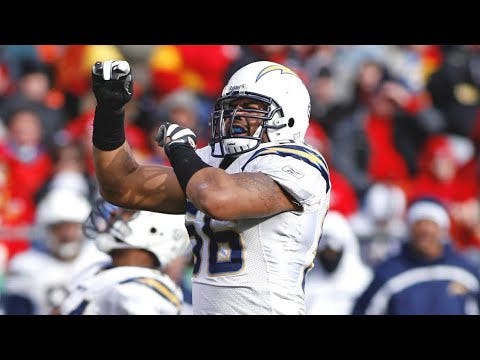
Shawne Merriman walked across the room ready to throw a punch at a player whose block had changed the trajectory of his career.
After hearing two words he wasn’t ready for, Merriman wound up in tears. I explain why in my most recent article at Grudgery, an editorial project dedicated to the dark art of staying mad and the relief that comes when you let go.