
Sports are among our last areas of common ground in this country.
It’s possible they are the last patch.
I’m not saying that this is a good thing, nor am I arguing that it is a bad one.
I am just stating the reality: This is how it is.
The audience for conventional television shows has fractured into hundreds of series scattered across dozens of streamers.
The national news programs produced by NBC, ABC and CBS are nowhere near as influential or respected as they once were.1 I remember Tom Brokaw pretty vividly, but you could give me 100 guesses on who currently hosts the NBC Nightly News, and I would not be able to tell you.
The two major political parties in this country essentially have separate cable-news networks at this point.
But sports?
Everybody watches sports.
And talks about sports.
And when the local sports team has gone half a century without winning a championship — as the Knicks have — everybody braves intolerably crowded subways and streets to celebrate sports.
Or when the men’s national soccer team comes to Seattle, a city that is particularly enthusiastic about soccer, and everyone in the Northwest puffs out their chest a bit because it is (still) a hell of a place to live.
OK, you know how I said that I wasn’t arguing this was a good thing or a bad thing? I lied.
It’s a good thing.
I wish there were more things we all agreed upon, but at least we haven’t lost sports. At least not yet.
More on that in a second, but on Wednesday, Washington coach Jedd Fisch stopped by our Husky podcast:


OK. Back to that thing about common ground.
Culture critics have come up with a fancy term for this: the monoculture.
This refers to the fact that we all had the same reference points and touchstones when it came to talking about things, whether it was the movies, television, or the news.
“The Cosby Show” and “Family Ties,” “Cheers” and later “Seinfeld” were all part of the monoculture. Even if you didn’t like these programs, even if you didn’t watch them, you were aware of their existence and (probably) their influence.
Do you know what the most-watched TV series is on television today?
I didn’t have the first foggiest clue. A quick Google search indicates it was (probably) “Stranger Things” according to Nielsen’s multi-platform (???) ranker. I have no idea how those rankings are calculated, let alone whether I should trust those rankings.
If you expand that to include NFL prime-time slots, “Stranger Things” ranked second, behind NBC’s Sunday Night Football but ahead of ESPN’s Monday Night Football.
In other words, the most popular television series in the country last year was watched by a larger number of people than the average Monday night football game, but less than the average Sunday night game.
Even that doesn’t quite capture football’s prominence: If we’re talking about individual telecasts from 2025, 96 of the 100 most-watched in the United States were live sports.
Now I am hardly the first person to make this point. I’ve heard comedian Nate Bargatze mention this frequently. Author and dorm-room philosopher Chuck Klosterman wrote a whole chapter about it in his (excellent) book “Football.”
It didn’t used to be like this. The reason I know this is that I performed some thoroughly half-assed research, by which I mean I consulted Wikipedia to find out what Nielsen listed as the most-watched television programs in the ‘80s.
“Monday Night Football” usually ranked in the latter teens, except for one year – 1984-’85 – when it was 25th, tied with Remington Steele.
Now, there is no doubt that football has become more popular over the past 40 years, even if Pierce Brosnan looks (fairly) similar.
So while football has become the undisputed alpha of American television, this isn’t just about football’s growth. It’s about how the audience for other forms of televised entertainment has splintered.
Not sports, though. It remains a common language.
It’s true on the national level with the NFL.
It’s true on the local level when a franchise gets on a run, and everyone in town and anyone who used to live in that town gets caught up in the momentum.
It’s true with the World Cup, which is happening right in front of us.

We tend to assume that people act in their own best interest.
This is not always true.
Resentment, and the grudges it can fuel, lead people to do things that hurt everyone, including themselves.
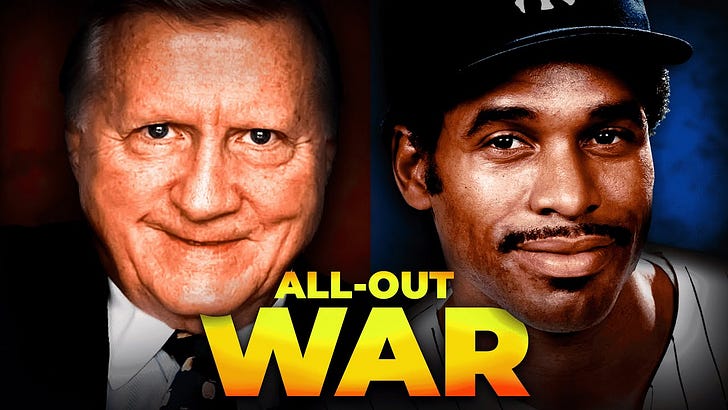
Sometimes, they’ll get you banned from managing the Major League Baseball team you own.
1 At least not until they are being dismantled, at which point a huge segment of the online commentariat rises up to bemoan the decline of a once-revered institution.